RESEARCH PAPER
Is tenofovir-based ART regimen challenging the survival of people living with HIV/AIDS attending a rural-based ART center of eastern India? A retrospective cohort study
1
Department of Anaesthesiology, Prafulla Chandra Sen Government Medical College, Arambag, Hooghly, West Bengal, India
2
Department of Community Medicine, Prafulla Chandra Sen Government Medical College, Arambag, Hooghly, West Bengal, India
Submission date: 2023-08-07
Acceptance date: 2024-01-01
Publication date: 2025-11-23
Corresponding author
HIV & AIDS Review 2025;24(4):302-310
KEYWORDS
TOPICS
ABSTRACT
Introduction:
This research was conducted to assess the predictors for poor survival of patients living with human immunodeficiency virus (HIV) in a rural-based setting.
Material and methods:
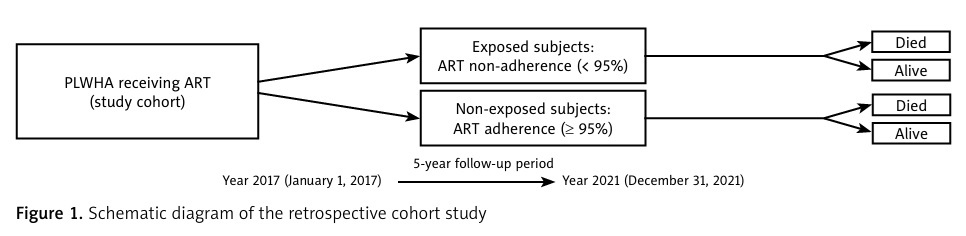
In this retrospective cohort study, 92 HIV-positive individuals were selected by a simple random sampling method out of a total of 853 patients, who registered at the anti-retroviral therapy (ART) clinic of Bankura Sammilani Medical College and Hospital before January 1, 2017. Selected participants were followed up until December 31, 2021, or until death, through reviewing secondary data, such as the ART enrolment register and the death register. Patients with incomplete data or who were transferred to other ART centers were excluded. Survival probability was expressed using life table and Kaplan-Meier plots. In bivariate analysis, statistically significant variables (p < 0.05) were considered for Cox regression model, from which, hazard ratio was assessed.
Results:
The overall HIV death incidence density rate from diagnosis until last observation was 2.65 per 100 person-years. In the last 5 years, the rate increased to 4.49 per 100 person-years. At the end of 5-year follow-up period, the cumulative survival probability was 79%. However, it is of concern that in the last year of follow-up, the survival probability drastically decreased from 90% to 79%. Patients who received TLE [tenofovir (TDF) + lamivudine (3TC) + efavirenz (EFV)] regimen for a maximum duration were found 2.83 times more vulnerable to death (hazard ratio = 2.830; 95% CI: 1.538-5.209%).
Conclusions:
Investigating the TLE regimen’s risk assessment is crucial for patient safety and better health outcomes.
This research was conducted to assess the predictors for poor survival of patients living with human immunodeficiency virus (HIV) in a rural-based setting.
Material and methods:
In this retrospective cohort study, 92 HIV-positive individuals were selected by a simple random sampling method out of a total of 853 patients, who registered at the anti-retroviral therapy (ART) clinic of Bankura Sammilani Medical College and Hospital before January 1, 2017. Selected participants were followed up until December 31, 2021, or until death, through reviewing secondary data, such as the ART enrolment register and the death register. Patients with incomplete data or who were transferred to other ART centers were excluded. Survival probability was expressed using life table and Kaplan-Meier plots. In bivariate analysis, statistically significant variables (p < 0.05) were considered for Cox regression model, from which, hazard ratio was assessed.
Results:
The overall HIV death incidence density rate from diagnosis until last observation was 2.65 per 100 person-years. In the last 5 years, the rate increased to 4.49 per 100 person-years. At the end of 5-year follow-up period, the cumulative survival probability was 79%. However, it is of concern that in the last year of follow-up, the survival probability drastically decreased from 90% to 79%. Patients who received TLE [tenofovir (TDF) + lamivudine (3TC) + efavirenz (EFV)] regimen for a maximum duration were found 2.83 times more vulnerable to death (hazard ratio = 2.830; 95% CI: 1.538-5.209%).
Conclusions:
Investigating the TLE regimen’s risk assessment is crucial for patient safety and better health outcomes.
REFERENCES (30)
1.
UNAIDS. Global HIV & AIDS statistics – Fact sheet. Available from: https://www.unaids.org/en/reso... (Accessed: 30.07.2023).
2.
Johnson SC. Antiretroviral therapy for HIV infection: when to initiate therapy, which regimen to use, and how to monitor patients on therapy. Top Antivir Med 2016; 23: 161-167.
3.
Mbirimtengerenji ND. Is HIV/AIDS epidemic outcome of poverty in sub-saharan Africa? Croat Med J 2007; 48: 605-617.
4.
National AIDS Control Organisation. HIV Facts & Figures. Available from: https://naco.gov.in/hiv-facts-... (Accessed: 30.07.2023).
5.
Moosavi S, Pokorny KL, Poorolajal J, Mahjub H. Fuzzy survival analysis of AIDS patients under ten years old in Hamadan-Iran. J Intell Fuzzy Syst 2015; 28: 1385-1392.
6.
Tadesse K, Haile F, Hiruy N. Predictors of mortality among patients enrolled on antiretroviral therapy in Aksum hospital, northern Ethiopia: a retrospective cohort study. PLoS One 2014; 9: e87392. DOI: 10.1371/journal.pone.0087392.
7.
Celesia BM, Castronuovo D, Pinzone MR, Bellissimo F, Mughi-ni MT, Lupo G, et al. Late presentation of HIV infection: predictors of delayed diagnosis and survival in Eastern Sicily. Eur Rev Med Pharmacol Sci 2013; 17: 2218-2224.
8.
Biadgilign S, Reda AA, Digaffe T. Predictors of mortality among HIV infected patients taking antiretroviral treatment in Ethiopia: a retrospective cohort study. AIDS Res Ther 2012; 9: 15. DOI: 10.1186/1742-6405-9-15.
9.
Siraj M, Gedamu S, Tegegne B. Predictors of survival time among HIV-infected adults after initiating anti-Retroviral therapy in kombolcha town: a 5-year retrospective cohort study. HIV AIDS (Auckl) 2022; 14: 181-194.
10.
Chanie ES, Gelaye GA, Tadesse TY, Feleke DG, Admas WT, Molla Alemu E, et al. Estimation of lifetime survival and predictors of mortality among TB with HIV co-infected children after test and treat strategies launched in Northwest, Ethiopia, 2021; a multicentre historical follow-up study. PLoS One 2021; 16: e0258964. DOI:10.1371/journal.pone.0258964.
11.
Pahari S, Roy S, Mandal A, Kuila S, Panda S. Adherence to anti-retroviral therapy & factors associated with it: a community based cross-sectional study from West Bengal, India. Indian J Med Res 2015; 142: 301-310.
12.
Paterson DL, Swindells S, Mohr J, Brester M, Vergis EN, Squier C, et al. Adherence to protease inhibitor therapy and outcomes in patients with HIV infection. Ann Intern Med 2000; 133: 21-30.
13.
Poorolajal J, Hooshmand E, Mahjub H, Esmailnasab N, Jenabi E. Survival rate of AIDS disease and mortality in HIV-infected patients: a meta-analysis. Public Health 2016; 139: 3-12.
14.
Varni SE, Miller CT, McCuin T, Solomon S. Disengagement and engagement coping with HIV/AIDS stigma and psychological well-being of people with HIV/AIDS. J Soc Clin Psychol 2012; 31: 123-150.
15.
Kaneez S. Depression and coping mechanism among HIV/AIDS patients under anti-retroviral therapy. Ind J Soc Psychiatr 2016; 32: 149. DOI: 10.4103/0971-9962.181098.
16.
Jain D, Kumar J, Katyal VK, Jain P, Malik D. Evaluation of depression, anxiety and insomnia in people living with HIV/AIDS in India. HIV AIDS Rev 2023; 22: 138-149.
17.
Rajasekar V, Thirunaaukarasu D, Surendar R. Socio-demographic profile and adherence to anti-retroviral treatment among HIV/AIDS patients attending the ART centre in Tamil Nadu. J Med Sci Health 2023; 9:163-168.
18.
Kumar P, Sahu D, Chandra N, Kumar A, Rajan S. Aging of HIV epidemic in India: insights from HIV estimation modeling under the National AIDS Control Programme. Indian J Public Health 2020; 64: 76-78.
19.
Mehta KG, Baxi R, Patel S, Parmar M. Drug adherence rate and loss to follow-up among people living with HIV/AIDS attending an ART Centre in a Tertiary Government Hospital in Western India. J Family Med Prim Care 2016; 5: 266-269.
20.
Akbari M, Fararouei M, Haghdoost AA, Gouya MM, Kazerooni PA. Survival and associated factors among people living with HIV/AIDS: a 30-year national survey in Iran. J Res Med Sci 2019; 24: 5. DOI: 10.4103/jrms.JRMS_630_18.
21.
Mohammadi Y, Mirzaei M, Farhadian M, Poorolajal J, Kaze rooni P, Tayeri K. Survival rate and the determinants of progression from HIV to AIDS and from AIDS to the death in Iran: 1987 to 2016. Asian Pac J Trop Med 2019; 12: 72. DOI: 10.4103/1995-7645.250840.
22.
Manosuthi W, Charoenpong L, Santiwarangkana C. A retrospective study of survival and risk factors for mortality among people living with HIV who received antiretroviral treatment in a resource-limited setting. AIDS Res Ther 2021; 18: 71. DOI: 10.1186/s12981021-00397-1.
23.
Moradi A, Hashemi Nazari SS, Zandvakili F, Ameri P, Nikfarjam A, Darvishi S, et al. Survival rate of patients with HIV/AIDS and related factors in Tehran, Iran. Shiraz E Med J 2020; 21. DOI: 10.5812/semj.98500.
24.
Badii VS, Buabeng KO, Agyarko Poku T, Forkuo AD, Boamah BB, Arhin SM, et al. Tenofovir-based highly active antiretroviral therapy is associated with superior CD4 T cells repopulation compared to zidovudine-based HAART in HIV 1 infected adults. Int J Chronic Dis 2018; 2018: 3702740. DOI: 10.1155/2018/3702740.
25.
Singla R, Sharma N. A comparative evaluation of the effects of ZLN and TLE anti-retroviral regimens in HIV positive patients: a retrospective record-based study. Indian J Physiol Pharmacol 2021; 64: 298-302.
26.
Bansal R, Ashahiya ID. Comparison between two regimens of art in human immunodeficiency virus patients at Tertiary Care Art Centre Jabalpur: a prospective observational study. Int J Sci Study 2018; 6: 62-66.
27.
Bangsberg DR, Hecht FM, Charlebois ED, Zolopa AR, Holodniy M, Sheiner L, et al. Adherence to protease inhibitors, HIV-1 viral load, and development of drug resistance in an indigent population. AIDS 2000; 14: 357-366.
28.
Moses K, Adefisayo OA, Maryam B, Adeoye A, Oluwatosin A, Abiye K, et al. Virologic response among key populations living with HIV following a switch to dolutegravir-based regimen in southern Nigeria. Int J Virol AIDS 2020; 7. DOI: 10.23937/2469-567x/1510069.
29.
Paul NI, Ugwu RO. Dolutegravir (DTG) based fixed dose combination (FDC) of tenofovir/lamivudine/dolutegravir (TLD) and viral load suppression in children in Port Harcourt, Nigeria. J Sci Res Rep 2020. DOI: 10.9734/jsrr/2020/v26i230224.
30.
Fettiplace A, Stainsby C, Winston A, Givens N, Puccini S, Vannappagari V, et al. Psychiatric symptoms in patients receiving dolutegravir. J Acquir Immune Defic Syndr 2017; 74: 423-431.
| eISSN: | 1732-2707 |
| ISSN: | 1730-1270 |

We process personal data collected when visiting the website. The function of obtaining information about users and their behavior is carried out by voluntarily entered information in forms and saving cookies in end devices. Data, including cookies, are used to provide services, improve the user experience and to analyze the traffic in accordance with the Privacy policy. Data are also collected and processed by Google Analytics tool (more).
You can change cookies settings in your browser. Restricted use of cookies in the browser configuration may affect some functionalities of the website.
You can change cookies settings in your browser. Restricted use of cookies in the browser configuration may affect some functionalities of the website.