RESEARCH PAPER
Effects of HIV infection on clinical and laboratory characteristics of sickle cell disease among patients in Homa Bay County Hospital, Kenya
1
Department of Pediatrics and Child Health, University of Nairobi, Nairobi, Kenya
2
Homa Bay County Teaching and Referral Hospital, Homa Bay County, Homa Bay, Kenya
Submission date: 2023-11-03
Acceptance date: 2024-04-02
Publication date: 2026-06-10
Corresponding author
HIV & AIDS Review 2026;25(3):228-233
KEYWORDS
TOPICS
ABSTRACT
Introduction:
This investigation provided insights on the clinical, laboratory, and nutritional characteristics in human immunodeficiency virus (HIV) and sickle cell disease (SCD) comorbidity. Information gained from this study have the potential to inform tailored and optimized healthcare approaches, ultimately enhancing the overall management and well-being of HIV-SCD patients.
Material and methods:
Conducted at the Homa Bay County Teaching and Referral Hospital in Kenya, this retrospective cohort study examined the effects of HIV infection on clinical, laboratory, and nutritional characteristics in HIV and SCD comorbidity. The research involved 101 HIV-positive SCD patients and 102 HIV-negative SCD patients, aged 2 to 17 years. This study aimed to understand the effect of HIV infection on SCD presentation. Data encompassed demographics, medical history, laboratory results, and nutritional assessment using weighing scale.
Results:
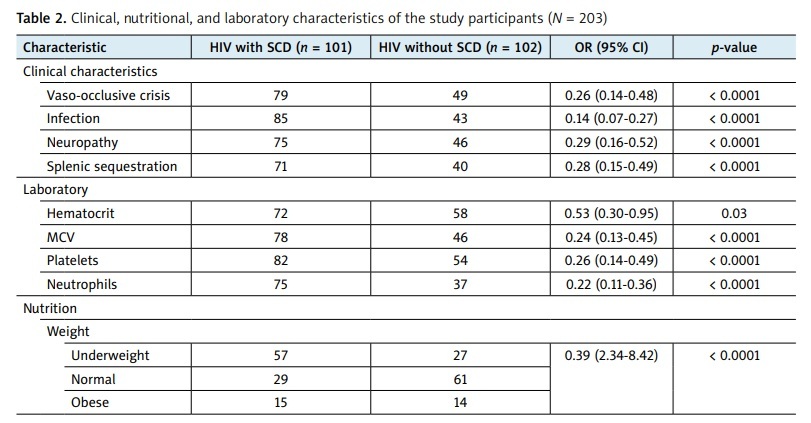
The study highlighted a significant clinical, laboratory, and nutritional association in HIV infection with SCD. HIV-positive participants had 1.26 times higher odds of vaso-occlusion (p < 0.0001), 1.14 times more infections (p < 0.0001), 1.28 times higher odds of developing neuropathy (p < 0.0001), and 1.29 times higher chance of suffering from splenic sequestration (p < 0.0001). HIV-SCD comorbidity was 1.332 times higher (p < 0.0001), and pain incidence was over 2 times more frequent (p = 0.0142). Laboratory data showed that HIV-infected SCD patients were 1.53 times more likely to suffer from anemia (p < 0.0001), 1.25 times more likely having higher mean corpuscular volume (p < 0.0001), 1.26 times more likely to suffer from platelets deficiency (p < 0.0001), and 1.2 times more probable to suffer from low neutrophil count (p < 0.0001). Whereas among HIV-negative SCD participants, this was 1.222 (95% CI: 1.113-1.435), with p < 0.0001. A statistically significant relationship between neutrophil count and HIV status was found, showing that HIV-negative SCD patients were more likely to have high neutrophils count compared with HIV-negative SCD patients. Nutritional status assessment using weighing scale revealed that HIV-positive SCD patients were 1.39 more likely to be underweight (p < 0.0001). Nutritional outcomes showed HIV-negative individuals were 1.601 times more likely to have normal weight than being underweight (p < 0.001), while overweight likelihood was not significant (p = 0.174).
Conclusions:
This study holds significance in adopting the best model of care for patients with HIV and SCD comorbidity, which may influence their frequent hospitalization, use of medication, i.e., antibiotic prophylaxis and vaccination.
This investigation provided insights on the clinical, laboratory, and nutritional characteristics in human immunodeficiency virus (HIV) and sickle cell disease (SCD) comorbidity. Information gained from this study have the potential to inform tailored and optimized healthcare approaches, ultimately enhancing the overall management and well-being of HIV-SCD patients.
Material and methods:
Conducted at the Homa Bay County Teaching and Referral Hospital in Kenya, this retrospective cohort study examined the effects of HIV infection on clinical, laboratory, and nutritional characteristics in HIV and SCD comorbidity. The research involved 101 HIV-positive SCD patients and 102 HIV-negative SCD patients, aged 2 to 17 years. This study aimed to understand the effect of HIV infection on SCD presentation. Data encompassed demographics, medical history, laboratory results, and nutritional assessment using weighing scale.
Results:
The study highlighted a significant clinical, laboratory, and nutritional association in HIV infection with SCD. HIV-positive participants had 1.26 times higher odds of vaso-occlusion (p < 0.0001), 1.14 times more infections (p < 0.0001), 1.28 times higher odds of developing neuropathy (p < 0.0001), and 1.29 times higher chance of suffering from splenic sequestration (p < 0.0001). HIV-SCD comorbidity was 1.332 times higher (p < 0.0001), and pain incidence was over 2 times more frequent (p = 0.0142). Laboratory data showed that HIV-infected SCD patients were 1.53 times more likely to suffer from anemia (p < 0.0001), 1.25 times more likely having higher mean corpuscular volume (p < 0.0001), 1.26 times more likely to suffer from platelets deficiency (p < 0.0001), and 1.2 times more probable to suffer from low neutrophil count (p < 0.0001). Whereas among HIV-negative SCD participants, this was 1.222 (95% CI: 1.113-1.435), with p < 0.0001. A statistically significant relationship between neutrophil count and HIV status was found, showing that HIV-negative SCD patients were more likely to have high neutrophils count compared with HIV-negative SCD patients. Nutritional status assessment using weighing scale revealed that HIV-positive SCD patients were 1.39 more likely to be underweight (p < 0.0001). Nutritional outcomes showed HIV-negative individuals were 1.601 times more likely to have normal weight than being underweight (p < 0.001), while overweight likelihood was not significant (p = 0.174).
Conclusions:
This study holds significance in adopting the best model of care for patients with HIV and SCD comorbidity, which may influence their frequent hospitalization, use of medication, i.e., antibiotic prophylaxis and vaccination.
REFERENCES (23)
1.
Sahu M, Biswas AK, Uma K. Detection of sickle cell anemia in red blood cell. Int J Eng Appl Sci 2015; 2: 45-48.
2.
Novelli EM, Gladwin MT. Crises in sickle cell disease. Chest 2016; 149: 1082-1093.
3.
Noubouossie D, Tayou Tagny C, Chetcha B, Ngo Balogog P, Mbanya DN. Sickle‐cell disease in sub‐Saharan Africa. ISBT Sci Ser 2016; 11 (Suppl 1): 256-262.
4.
Kharsany AB, Karim QA. HIV infection and AIDS in sub-Saharan Africa: current status, challenges and opportunities. Open AIDS J 2016; 10: 34-48.
5.
Garrett L. The challenge of global health. In: Garrett L (ed.). Global Health. Routledge; 2017, pp. 525-548.
6.
Amuche NJ, Emmanuel EI, Innocent NE. HIV/AIDS in sub-Saharan Africa: current status, challenges and prospects. Asian Pac J Trop Dis 2017; 7: 239-256.
7.
Owusu ED, Visser BJ, Nagel IM, Mens PF, Grobusch MP. The interaction between sickle cell disease and HIV infection: a systematic review. Clin Infect Dis 2015; 60: 612-626.
8.
Wang Z, Andrews MA, Wu ZX, Wang L, Bauch CT. Coupled disease–behavior dynamics on complex networks: a review. Phys Life Rev 2015; 15: 1-29.
9.
Mburu J, Odame I. Sickle cell disease: reducing the global disease burden. Int J Lab Hematol 2019; 41: 82-88.
10.
Hoban MD, Orkin SH, Bauer DE. Genetic treatment of a molecular disorder: gene therapy approaches to sickle cell disease. Blood 2016; 127: 839-848.
11.
Sundd P, Gladwin MT, Novelli EM. Pathophysiology of sickle cell disease. Ann Rev Pathol 2019; 14: 263-292.
12.
Telen MJ, Malik P, Vercellotti GM. Therapeutic strategies for sickle cell disease: towards a multi-agent approach. Nat Rev Drug Discov 2019; 18: 139-158.
13.
Kato GJ, Piel FB, Reid CD, Gaston MH, Ohene-Frempong K, Krishnamurti L, et al. Sickle cell disease. Nat Rev Dis Primers 2018; 4: 18010. DOI: https://doi.org/10.1038/nrdp.2....
14.
Guarda CC, Silveira-Mattos PS, Yahouédéhou SC, Santiago RP, Aleluia MM, Figueiredo CV, et al. Hydroxyurea alters circulating monocyte subsets and dampens its inflammatory potential in sickle cell anemia patients. Sci Rep 2019; 9: 14829. DOI: 10.1038/s41598-019-51339-x.
15.
David AN, Jinadu MY, Wapmuk AE, Gbajabiamila TA, Okwuzu JO, Herbertson EC, Ezechi OC. Prevalence and impact of sickle cell trait on the clinical and laboratory parameters of HIV infected children in Lagos, Nigeria. Pan Afr Med J 2018; 31: 113. DOI: 10.11604/pamj.2018.31.113.15097.
16.
Mabayoje VO. Haematological manifestations. In: Olufunmilayo AOE, Christopher AO (eds.). New Insights into HIV/AIDS for Students and Healthcare Professionals. Cambridge: Cambridge Scholars Publishing; 2019.
17.
Belisário AR, Blatyta PF, Vivanco D, Oliveira C. Association of HIV infection with clinical and laboratory characteristics of sickle cell disease. BMC Infect Dis 2020; 20: 638. DOI: https://doi.org/10.1186/s12879....
18.
Blake A, Asnani V, Leger RR, Harris J, Odesina V, Hemmings DL, et al. Stigma and illness uncertainty: adding to the burden of sickle cell disease. Hematology 2018; 23: 122-130.
19.
Cannas G, Merazga S, Virot E. Sickle cell disease and infections in high-and low-income countries. Mediterranean J Hematol Infect Dis 2019; 11: e2019042. DOI: 10.4084/MJHID.2019.042.
20.
Vishnu P, Aboulafia DM. Haematological manifestations of human immune deficiency virus infection. Br J Haematol 2015; 171: 695-709.
21.
Tomaiuolo G. Biomechanical properties of red blood cells in health and disease towards microfluidics. Biomicrofluidics 2014; 8: 051501. DOI: 10.1063/1.4895755.
22.
Dai DM, Wang D, Hu D, Wan WL, Su Y, Yang JL, et al. Difference in hematocrit and plasma albumin levels as an additional biomarker in the diagnosis of infectious disease. Arch Med Sci 2019; 16: 522-530.
23.
Mandese V, Marotti F, Bedetti L, Bigi E, Palazzi G, Iughetti L. Effects of nutritional intake on disease severity in children with sickle cell disease. Nutr J 2015; 15: 46. DOI: 10.1186/s12937-016-0159-8.
Share
RELATED ARTICLE
| eISSN: | 1732-2707 |
| ISSN: | 1730-1270 |

We process personal data collected when visiting the website. The function of obtaining information about users and their behavior is carried out by voluntarily entered information in forms and saving cookies in end devices. Data, including cookies, are used to provide services, improve the user experience and to analyze the traffic in accordance with the Privacy policy. Data are also collected and processed by Google Analytics tool (more).
You can change cookies settings in your browser. Restricted use of cookies in the browser configuration may affect some functionalities of the website.
You can change cookies settings in your browser. Restricted use of cookies in the browser configuration may affect some functionalities of the website.