RESEARCH PAPER
Patients’ perceptions on factors contributing to defaulting from antiretroviral treatment
at a selected clinic in Vhembe District, Limpopo Province
1
Department of Health Studies, College of Human Sciences, University of South Africa, Pretoria, South Africa
Submission date: 2022-09-27
Final revision date: 2023-03-14
Acceptance date: 2023-03-15
Publication date: 2025-09-07
Corresponding author
Sheillah Hlamalani Mboweni
Department of Health Studies, College of Human Sciences, University of South Africa, City of Ekurhuleni, Cnr Long and Monument Rd. Kempton Park, Johannesburg, South Africa
Department of Health Studies, College of Human Sciences, University of South Africa, City of Ekurhuleni, Cnr Long and Monument Rd. Kempton Park, Johannesburg, South Africa
HIV & AIDS Review 2025;24(3):215-223
KEYWORDS
TOPICS
ABSTRACT
Introduction:
South Africa has the world’s largest antiretroviral therapy (ART) program. However, a high default rate was observed in most districts of Limpopo Province among people living with human immunodeficiency virus (HIV) on antiretroviral treatment, which has an impact on the achievement of 95-95-95 strategy. In that strategy, the second and third 95s are retention into care and viral load suppression, which are severely affected. The current study seeks to determine patients’ perceptions regarding the factors contributing to defaulting from antiretroviral treatment at a selected clinic. The study aim to explore and describe patients’ perceptions on the factors contributing to defaulting from antiretroviral treatment. The study was conducted in a selected clinic in the Vhembe District.
Material and methods:
A qualitative descriptive, exploratory, and contextual study design was used in this study. A non-probability purposive sampling method was applied to select adults living with HIV, who have defaulted from ART and were lost to follow-up. Unstructured individual face-to-face interviews were employed to collect data from 13 participants, and obtained data were evaluated using Tesch’s eight-step data analysis.
Results:
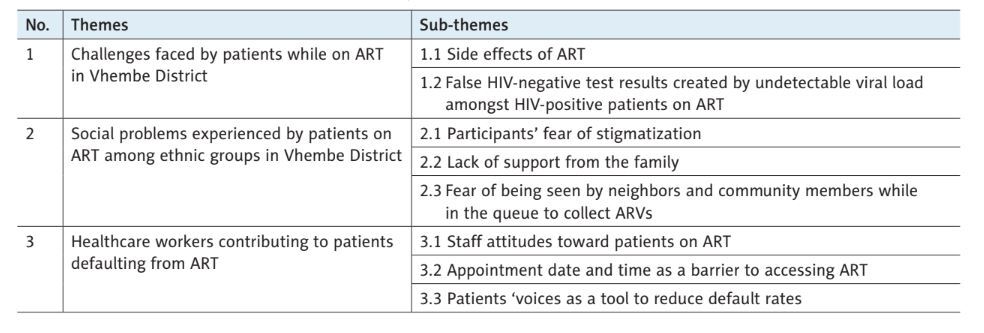
The findings of the study resulted in three themes: 1) challenges faced by patients while on ART; 2) social problems experienced by patients on ART; and 3) healthcare workers' attitudes contributing to patients defaulting from ART. The identified factors contributing to patients defaulting from ART included staff attitude, treatment side effects, lack of knowledge, and lack of family support.
Conclusions:
Patients’ defaulting from ART is a marker of poor adherence to treatment, leading to resistance. Healthcare system will continue to bear the burden of the disease affecting socio-economic status of the country and reduction in the life span of the population; therefore, these factors should be considered decisively.
South Africa has the world’s largest antiretroviral therapy (ART) program. However, a high default rate was observed in most districts of Limpopo Province among people living with human immunodeficiency virus (HIV) on antiretroviral treatment, which has an impact on the achievement of 95-95-95 strategy. In that strategy, the second and third 95s are retention into care and viral load suppression, which are severely affected. The current study seeks to determine patients’ perceptions regarding the factors contributing to defaulting from antiretroviral treatment at a selected clinic. The study aim to explore and describe patients’ perceptions on the factors contributing to defaulting from antiretroviral treatment. The study was conducted in a selected clinic in the Vhembe District.
Material and methods:
A qualitative descriptive, exploratory, and contextual study design was used in this study. A non-probability purposive sampling method was applied to select adults living with HIV, who have defaulted from ART and were lost to follow-up. Unstructured individual face-to-face interviews were employed to collect data from 13 participants, and obtained data were evaluated using Tesch’s eight-step data analysis.
Results:
The findings of the study resulted in three themes: 1) challenges faced by patients while on ART; 2) social problems experienced by patients on ART; and 3) healthcare workers' attitudes contributing to patients defaulting from ART. The identified factors contributing to patients defaulting from ART included staff attitude, treatment side effects, lack of knowledge, and lack of family support.
Conclusions:
Patients’ defaulting from ART is a marker of poor adherence to treatment, leading to resistance. Healthcare system will continue to bear the burden of the disease affecting socio-economic status of the country and reduction in the life span of the population; therefore, these factors should be considered decisively.
REFERENCES (25)
1.
UNAIDS. UNAIDS data 2022 [Internet]. 2022. Available from: https://www.unaids.org/en/regi... (Accessed: 26.12.2022).
2.
World Bank. Population growth (annual %) | Data [Internet]. Available from: https://data.worldbank.org/ind... (Accessed: 26.12.2022).
3.
Kharsany ABM, Cawood C, Lewis L, Yende-Zuma N, Khanyile D, Puren A, et al. Trends in HIV prevention, treatment, and incidence in a hyperendemic area of KwaZulu-Natal, South Africa. JAMA Netw Open 2019; 2: e1914378. DOI: 10.1001/jamanetworkopen.2019.14378.
4.
Eamsakulrat P, Kiertiburanakul S. The impact of timing of antiretroviral therapy initiation on retention in care, viral load suppression and mortality in people living with HIV: a study in a University Hospital in Thailand. J Int Assoc Provid AIDS Care 2022; 21: 23259582221082610. DOI: 10.1177/23259582221082607.
5.
Kim J, Lee E, Park BJ, Bang JH, Lee JY. Adherence to antiretroviral therapy and factors affecting low medication adherence among incident HIV-infected individuals during 2009-2016: a nationwide study. Sci Rep 2018; 8: 3133. DOI: 10.1038/s41598-018-21081-x.
6.
Kaplan S, Nteso KS, Ford N, Boulle A, Meintjes G. Loss to follow-up from antiretroviral therapy clinics: a systematic review and meta-analysis of published studies in South Africa from 2011 to 2015. South Afr J HIV Med 2019; 20: 984. DOI: https://dx.doi.org/10.4102/saj....
7.
Castelnuovo B, Kiragga A, Musaazi J, Sempa J, Mubiru F, Wanyama J, et al. Outcomes in a cohort of patients started on antiretroviral treatment and followed up for a decade in an urban clinic in Uganda. PLoS One 2015; 10: e0142722. DOI: 10.1371/journal.pone.0142722.
8.
Christensen M, Welch A, Barr J. Husserlian Descriptive Phenomenology: a review of intentionality, reduction, and the natural attitude. J Nurs Educ Pract 2017; 7: 113. DOI: 10.5430/jnep.v7n8-p113.
9.
Burns N, Grove SK. Understanding Nursing Research: Building an Evidence-Based Practice. 9th ed. Philadelphia: Saunders; 2017.
10.
Brink H, Van der Walt C, Van Rensburg GH. Fundamentals of Research Methodology for Health Care Professionals. 4th ed. Cape Town, South Africa: Juta; 2018, p. 280.
11.
Anderson C. Presenting and evaluating qualitative research. Am J Pharm Educ 2010; 74: 141. DOI: 10.5688/aj7408141.
12.
Babbie ER. The Practice of Social Research. 15th ed. Belmont, CA, London: Wadsworth 2017, p. 530.
13.
Creswell JW, Creswell D. Research Design: Qualitative, Quantitative, and Mixed Methods Approaches. 4th ed. Thousand Oaks: SAGE Publications; 2017, p. 340.
14.
Cruz CCP, Mistro S, Cardeal Mendes CM, Turner Schooley R, da Silva Badaró RJ, et al. Monitoring of delay to pharmacy refill in assessing adherence to antiretroviral therapy. J Pharm Pract 2020; 33: 158-163.
15.
Pebody. Undetectable viral load and transmission – information for people with HIV [Internet]. aidsmap.com. 2019. Available from: https://www.aidsmap.com/about-... (Accessed: 21.09.2022).
16.
Dutt S. Importance of patient adherence and compliance in the present day. J Bacteriol Mycol Open Access 2017; 4: 150-152.
17.
Adeniyi OV, Ajayi AI, Ter Goon D, Owolabi EO, Eboh A, Lambert J. Factors affecting adherence to antiretroviral therapy among pregnant women in the Eastern Cape, South Africa. BMC Infect Dis 2018; 18: 175. DOI: 10.1186/s12879-018-3087-8.
18.
Mohammed A, Abdi S, Palani S, Joseph NM. Moderate incidence of lost follow-up and risk factors among adult HIV patients on second-line ART regimens in Amhara region hospitals, Ethiopia. J Drug Deliver Ther 2019; 9: 52-59.
19.
Seeling S, Mavhunga F, Thomas A, Adelberger B, Ulrichs T. Barriers to access to antiretroviral treatment for HIV-positive tuberculosis patients in Windhoek, Namibia. Int J Mycobacteriol 2014; 3: 268-275.
20.
Edwards RJ, Cyrus E, Bhatt C, Lyons N, Lavia LO, Boyce G. Viral suppression among persons living with HIV in Trinidad & Tobago: implications for targeted prevention programmes. Glob Public Health 2019; 14: 1569-1577.
21.
Mutabazi J, Gray C, Muhwava L, Trottier H, Ware LJ, Norris S, et al. Integrating the prevention of mother-to-child transmission of HIV into primary healthcare services after AIDS denialism in South Africa: perspectives of experts and health care workers – a qualitative study. BMC Health Serv Res 2020; 20: 582. DOI: https://doi.org/10.1186/s12913....
22.
Farhoudi B, Alipour A, Ghodrati S, Seyed Alinaghi SA, Zanganeh M, Mohraz M. Barriers to adherence to antiretroviral treatment among inmates of a prison in Tehran, Iran: a qualitative study. Arch Clin Infect Dis 2018; 13: e57911. DOI: 10.5812/archcid.57911.
23.
Tweya H, Oboho IK, Gugsa ST, Phiri S, Rambiki E, Banda R, et al. Loss to follow-up before and after initiation of antiretroviral therapy in HIV facilities in Lilongwe, Malawi. PLoS One 2018; 13: e0188488. DOI: https://doi.org/10.1371/journa....
24.
Decroo T, Telfer B, Dores CD, White RA, Santos ND, Mkwamba A, et al. Effect of Community ART Groups on retention-in-care among patients on ART in Tete Province, Mozambique: a cohort study. BMJ Open 2017; 7: e016800. DOI: 10.1136/ bmjopen-2017-016800.
25.
Brittain K, Mellins CA, Remien RH, Phillips T, Zerbe A, Abrams EJ, Myer L. Patterns and predictors of HIV-status disclosure among pregnant women in South Africa: dimensions of disclosure and influence of social and economic circumstances. AIDS Behav 2018; 22: 3933-3944.
Share
RELATED ARTICLE
| eISSN: | 1732-2707 |
| ISSN: | 1730-1270 |

We process personal data collected when visiting the website. The function of obtaining information about users and their behavior is carried out by voluntarily entered information in forms and saving cookies in end devices. Data, including cookies, are used to provide services, improve the user experience and to analyze the traffic in accordance with the Privacy policy. Data are also collected and processed by Google Analytics tool (more).
You can change cookies settings in your browser. Restricted use of cookies in the browser configuration may affect some functionalities of the website.
You can change cookies settings in your browser. Restricted use of cookies in the browser configuration may affect some functionalities of the website.