RESEARCH PAPER
Impact of antiretroviral therapy on cervical pre-cancerous lesions: a prospective cohort study from a tertiary care institute in India
1
Kidwai Memorial Institute of Oncology, Bengaluru, India
2
Military Hospital Kirkee, Pune, India
3
Command Hospital (Central Command), Lucknow, India
4
Armed Forces Medical College, Pune, India
Submission date: 2023-10-18
Final revision date: 2024-05-10
Acceptance date: 2024-05-12
Publication date: 2025-07-15
Corresponding author
Vinod G. Nair
Command Hospital (Central Command), Cariappa Road, Near Hdfc Bank, Neil Lines, Cantonment, Lucknow, Uttar Pradesh 226014, India
Command Hospital (Central Command), Cariappa Road, Near Hdfc Bank, Neil Lines, Cantonment, Lucknow, Uttar Pradesh 226014, India
HIV & AIDS Review 2025;24(3):201-205
KEYWORDS
TOPICS
ABSTRACT
Introduction:
Women living with human immunodeficiency virus (HIV) are at an increased risk for development of persistent human papillomavirus (HPV) infection, and expansion of precancerous lesions and invasive carcinoma of cervix. There is paucity of data from developing countries regarding HIV infection and its correlation with CD4+ counts.
Material and methods:
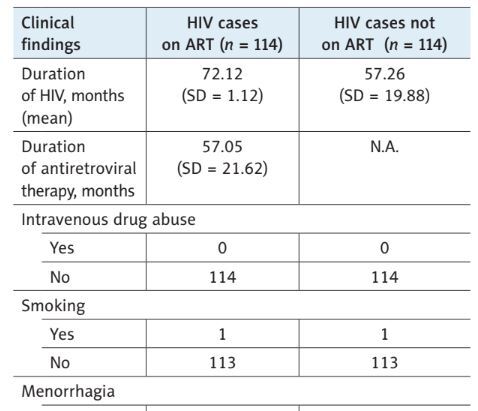
A hospital-based, observational, prospective cohort study was conducted at the antiretroviral therapy (ART) center of tertiary referral institute in South India. The aim of the study was to analyze the cytological abnormalities in women living with HIV, and compare the differences between patients on and not on ART. A detailed history and complete general and systemic examination were performed, followed by Pap smear.
Results:
The study included 228 women living with HIV, aged over 18 years, attending ART center OPD; 114 patients were on first-line ART for at least one year duration, and 114 were not on ART. In both the on ART and not on ART groups, the most commonly reported abnormal cytology report was inflammatory smear (36% and 25.4%) and bacterial vaginosis (9.6% and 10.5%), followed by low-grade squamous intra-epithelial lesion (16.7% and 14.9%). In high-grade squamous intra-epithelial lesion patients (n = 8), CD4+ counts were not found significantly different between those on and not on ART (p = 0.25).
Conclusions:
The current study reflects the absence of differences between cytological abnormalities in women on ART and not on ART as well as the lack of protective effect with the former on squamous intra-epithelial lesion.
Women living with human immunodeficiency virus (HIV) are at an increased risk for development of persistent human papillomavirus (HPV) infection, and expansion of precancerous lesions and invasive carcinoma of cervix. There is paucity of data from developing countries regarding HIV infection and its correlation with CD4+ counts.
Material and methods:
A hospital-based, observational, prospective cohort study was conducted at the antiretroviral therapy (ART) center of tertiary referral institute in South India. The aim of the study was to analyze the cytological abnormalities in women living with HIV, and compare the differences between patients on and not on ART. A detailed history and complete general and systemic examination were performed, followed by Pap smear.
Results:
The study included 228 women living with HIV, aged over 18 years, attending ART center OPD; 114 patients were on first-line ART for at least one year duration, and 114 were not on ART. In both the on ART and not on ART groups, the most commonly reported abnormal cytology report was inflammatory smear (36% and 25.4%) and bacterial vaginosis (9.6% and 10.5%), followed by low-grade squamous intra-epithelial lesion (16.7% and 14.9%). In high-grade squamous intra-epithelial lesion patients (n = 8), CD4+ counts were not found significantly different between those on and not on ART (p = 0.25).
Conclusions:
The current study reflects the absence of differences between cytological abnormalities in women on ART and not on ART as well as the lack of protective effect with the former on squamous intra-epithelial lesion.
REFERENCES (14)
2.
Bekolo CE, O’Bryan G, Tchago FE, Nangue C, Bekoule PS, Kollo B. Integrating cervical cancer screening with HIV care in Cameroon: comparative risk analysis of cervical disease in HIV-infected women receiving antiretroviral therapy to women in the general population. PLos One 2016; 11: e0149152. DOI: 10.1371/journal.pone.0149152.
3.
Peedicayil A, Thiyagarajan K, Gnanamony M, Pulimood SA, Jeyaseelan V, Kannangai R, et al. Prevalence and risk factors for human papillomavirus and cervical intraepithelial neoplasia among HIV-positive women at a tertiary level hospital in India. J Low Genit Tract Dis 2009; 13: 159-164.
4.
Harris TG, Burk RD, Palefsky JM, Massad LS, Bang JY, Anastos K, et al. Incidence of cervical squamous intraepithelial lesions associated with HIV serostatus, CD4 cell counts, and human papillomavirus test results. JAMA 2005; 293: 1471-1476.
5.
Kahesa C, Mwaiselage J, Wabinga HR, Ngoma T, Kalyango JN, Karamagi CA. Association between invasive cancer of the cervix and HIV-1 infection in Tanzania: the need for dual screening. BMC Public Health 2008; 8: 262. DOI: 10.1186/1471-2458-8-262.
6.
Sirera G, Videla S, López-Blázquez R, Llatjos M, Tarrats A, Castellà E, et al. Evolution of cervical cytologic changes among HIV-infected women with normal cytology in the HAART eEra. AIDS Res Hum Retroviruses 2007; 23: 965-971.
7.
Schuman P, Ohmit SE, Klein RS, Duerr A, Cu-Uvin S, Jamieson DJ, et al. Longitudinal study of cervical squamous intraepithelial lesions in human immunodeficiency virus (HIV)-seropositive and at-risk HIV-seronegative women. J Infect Dis 2003; 188: 128-136.
8.
Sirera G, Videla S, López-Blázquez R, Llatjos M, Tarrats A, Castellà E, et al. Highly active antiretroviral therapy and incidence of cervical squamous intraepithelial lesions among HIV-infected women with normal cytology and CD4 counts above 350 cells/mm3. J Antimicrob Chemother 2008; 61: 191-194.
9.
Moscicki AB, Shiboski S, Broering J, Powell K, Clayton L, Jay N, et al. The natural history of human papillomavirus infection as measured by repeated DNA testing in adolescent and young women. J Pediatr 1998; 132: 277-284.
10.
Delmas MC, Larsen C, van Benthem B, Hamers FF, Bergeron C, Poveda JD, et al. Cervical squamous intraepithelial lesions in HIV-infected women: prevalence, incidence and regression. AIDS 2000; 14: 1775-1784.
11.
Cardillo M, Hagan R, Abadi J, Abadi MA. CD4 T-cell count, viral load, and squamous intraepithelial lesions in women infected with the human immunodeficiency virus. Cancer 2001; 93: 111-114.
12.
Meys R, Gotch FM, Bunker CB. Human papillomavirus in the era of highly active antiretroviral therapy for human immunodeficiency virus: an immune reconstitution-associated disease? Br J Dermatol 2010; 162: 6-11.
13.
Lopez AD, Mathers CD. Measuring the global burden of disease and epidemiological transitions: 2002-2030. Ann Trop Med Parasitol 2006; 100: 481-499.
14.
Karim QA, Kharsany AB. Epidemiology of HIV/AIDS. In: HIV/AIDS in the Post-HAART Era: Manifestation, Treatment and Epidemiology. Hall JC, Hall BJ, Cockerell CJ (eds.). Shelton, CT: People's Medical Publishing House 2011, pp. 81-97.
Share
RELATED ARTICLE
| eISSN: | 1732-2707 |
| ISSN: | 1730-1270 |

We process personal data collected when visiting the website. The function of obtaining information about users and their behavior is carried out by voluntarily entered information in forms and saving cookies in end devices. Data, including cookies, are used to provide services, improve the user experience and to analyze the traffic in accordance with the Privacy policy. Data are also collected and processed by Google Analytics tool (more).
You can change cookies settings in your browser. Restricted use of cookies in the browser configuration may affect some functionalities of the website.
You can change cookies settings in your browser. Restricted use of cookies in the browser configuration may affect some functionalities of the website.