RESEARCH PAPER
Identifying the role of emotional factors in the adoption of HIV/AIDS risky behaviors in Iranian young people: a qualitative study
1
Student Research Committee, School of Health, Isfahan University of Medical Sciences, Isfahan, Iran
2
Department of Health Education and Health Promotion, School of Health, Isfahan University of Medical Sciences, Isfahan, Iran
3
Isfahan Cardiovascular Research Center, Cardiovascular Research Institute, Isfahan University of Medical Sciences, Isfahan, Iran
Submission date: 2024-02-17
Final revision date: 2024-05-25
Acceptance date: 2024-05-27
Publication date: 2026-09-25
Corresponding author
Ahmadali Eslami
Department of Health Education and Health Promotion, School of Health, Isfahan University of Medical Sciences, Isfahan, Iran
Department of Health Education and Health Promotion, School of Health, Isfahan University of Medical Sciences, Isfahan, Iran
HIV & AIDS Review 2026;25(3):256-262
KEYWORDS
TOPICS
ABSTRACT
Introduction:
Youth are now among the most at risk for human immunodeficiency virus (HIV) infection. Approximately half of the individuals with HIV diagnosis became infected before the age of 25 years. The current qualitative study was conducted to identify emotional aspects of HIV/acquired immune deficiency syndrome (AIDS) risky behaviors in Iranian young people.
Material and methods:
Data were collected among young people to explore emotional aspects of HIV/AIDS risky behaviors using directed content analysis. Study population consisted of youth considered key informants and willing to participate in the current study. To improve the results and data saturation, other participants were also enrolled, including parents, family members, friends, and relatives of young people as well as counselors, infectious disease specialists, coaches, university professors, and those with whom these young people were in contact. An in-depth, face-to-face, semi-structured interview was implemented as the primary data collection technique.
Results:
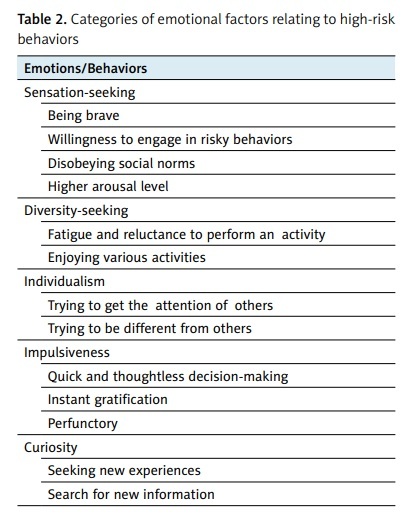
The study cohort consisted of 43 individuals, including 23 females and 20 males, with a mean age of 30.19 years. Of the 43 participants, 29 (67.4%) were single, 11 (25.6%) were married, and 3 (7.0%) were divorced. In examining the factors contributing to high-risk behaviors associated with HIV/AIDS, individual characteristics played a significant role, among which emotions emerged as a crucial factor. Persons engaging in high-risk behaviors often exhibited diverse characteristics, such as individualism, excitement, impulsiveness, and curiosity. These emotional dimensions can influence decision-making and risk-taking behaviors, potentially impacting the spread of HIV/AIDS.
Conclusions:
Individual factors, including personality traits, play a significant role in the emergence and persistence of high-risk behaviors, which lead to HIV/AIDS in young people. The results of the current study may be useful for researchers in HIV/AIDS prevention.
Youth are now among the most at risk for human immunodeficiency virus (HIV) infection. Approximately half of the individuals with HIV diagnosis became infected before the age of 25 years. The current qualitative study was conducted to identify emotional aspects of HIV/acquired immune deficiency syndrome (AIDS) risky behaviors in Iranian young people.
Material and methods:
Data were collected among young people to explore emotional aspects of HIV/AIDS risky behaviors using directed content analysis. Study population consisted of youth considered key informants and willing to participate in the current study. To improve the results and data saturation, other participants were also enrolled, including parents, family members, friends, and relatives of young people as well as counselors, infectious disease specialists, coaches, university professors, and those with whom these young people were in contact. An in-depth, face-to-face, semi-structured interview was implemented as the primary data collection technique.
Results:
The study cohort consisted of 43 individuals, including 23 females and 20 males, with a mean age of 30.19 years. Of the 43 participants, 29 (67.4%) were single, 11 (25.6%) were married, and 3 (7.0%) were divorced. In examining the factors contributing to high-risk behaviors associated with HIV/AIDS, individual characteristics played a significant role, among which emotions emerged as a crucial factor. Persons engaging in high-risk behaviors often exhibited diverse characteristics, such as individualism, excitement, impulsiveness, and curiosity. These emotional dimensions can influence decision-making and risk-taking behaviors, potentially impacting the spread of HIV/AIDS.
Conclusions:
Individual factors, including personality traits, play a significant role in the emergence and persistence of high-risk behaviors, which lead to HIV/AIDS in young people. The results of the current study may be useful for researchers in HIV/AIDS prevention.
REFERENCES (45)
1.
De Cock KM, Jaffe HW, Curran JW. Reflections on 40 years of AIDS. Emerg Infect Dis 2021; 27: 1553-1560.
2.
Peters R. Fighting the good fight: nearly four decades after the first diagnosis, the fight to treat HIV/AIDs continues. BioPharm Int 2019; 32: 5-6.
3.
Bosh KA, Hall HI, Eastham L, Daskalakis DC, Mermin JH. Estimated annual number of HIV infections – United States, 1981-2019. MMWR Morb Mortal Wkly 2021; 70: 801-806.
4.
Tian X, Chen J, Wang X, Xie Y, Zhang X, Han D, et al. Global, regional, and national HIV/AIDS disease burden levels and trends in 1990-2019: a systematic analysis for the global burden of disease 2019 study. Front Public Health 2023; 11: 1068664. DOI: 10.3389/fpubh.2023.1068664.
5.
Reshadat-Hajiabad T, Khajavi A, Hosseinpour AM, Bojdy A, Hashemi-Meshkini A, Varmaghani M. Determinants and economic burden of HIV/AIDS in Iran: a prospective study. BMC Health Serv Res 2023; 23: 251. DOI: 10.1186/s12913-023-09229-6.
6.
Xu B, Li J, Wang M. Epidemiological and time series analysis on the incidence and death of AIDS and HIV in China. BMC Public Health 2020; 20: 1906. DOI: 10.1186/s12889-020-09977-8.
7.
Mami D, Cuthrell KM, Manteghian M. Burden of HIV on society current management options and future prospective. Int STD Res Rev 2024; 13: 43-62.
8.
Davids EL. Factors that influence adolescents condom use decision-making in the Western Cape, South Africa. University of Cape Town; 2019. Available at: https://open.uct.ac.za/items/a....
9.
Kerrigan D, Kennedy CE, Morgan-Thomas R, Reza-Paul S, Mwangi P, Win KT, et al. A community empowerment approach to the HIV response among sex workers: effectiveness, challenges, and considerations for implementation and scale-up. Lancet 2015; 385: 172-185.
10.
Nguyen PT, Gilmour S, Le PM, Nguyen TT, Tanuma J, Nguyen HV. Factors associated with high-risk behaviors of people newly diagnosed with HIV/AIDS: results from a cross-sectional study in Vietnam. AIDS Care 2021; 33: 607-615.
11.
Naidoo P, Chirinda W, Mchunu G, Swartz S, Anderson J. Social and structural factors associated with vulnerability to HIV infection among young adults in South Africa. Psychol Health Med 2015; 20: 369-379.
12.
Morrison-Beedy D, Grove L, Ji M, Baker E. Understanding the “why” for high-risk behavior: Adolescent girls’ motivations for sex. J Assoc Nurses AIDS Care 2017; 28: 877-887.
13.
Probst C, Simbayi LC, Parry CD, Shuper PA, Rehm J. Alcohol use, socioeconomic status and risk of HIV infections. AIDS Behav 2017; 21: 1926-1937.
14.
Kasahun AW, Yitayal M, Girum T, Mohammed B. Risky sexual behavior and associated factors among high school students in Gondar City, Northwest Ethiopia. Int J Public Health Sci 2017; 6: 257-265.
15.
Chandler R, Anstey EH, Ross H, Morrison-Beedy D. Perceptions of Black college women on barriers to HIV-risk reduction and their HIV prevention intervention needs. J Assoc Nurses AIDS Care 2016; 27: 392-403.
16.
Lando-King E, McRee A-L, Gower AL, Shlafer RJ, McMorris BJ, Pettingell S, et al. Relationships between social-emotional intelligence and sexual risk behaviors in adolescent girls. J Sex Res 2015; 52: 835-840.
17.
Mohammadi Y, Mirzaei M, Shirmohammadi-Khorram N, Farhadian M. Identifying risk factors for late HIV diagnosis and survival analysis of people living with HIV/AIDS in Iran (1987-2016). BMC Infect Dis 2021; 21: 390. DOI: 10.1186/s12879-021-06100-z.
18.
Parker C, Scott S, Geddes A. Snowball sampling. In: SAGE Research Methods Foundations 2019. https://doi.org/10.11157/anzsw....
19.
Raisi F, Yekta ZP, Ebadi A, Shahvari Z. What are Iranian married women’s rewards? Using interpersonal exchange model of sexual satisfaction: a qualitative study. Sex Relatsh Ther 2015; 30: 475-489.
20.
Elo S, Kääriäinen M, Kanste O, Pölkki T, Utriainen K, Kyngäs H. Qualitative content analysis: a focus on trustworthiness. SAGE Open 2014; 4: 2158244014522633. DOI: https://doi.org/10.1177/215824....
21.
Oakley A, Fullerton D, Holland J. Behavioural interventions for HIV/AIDS prevention. AIDS 1995; 9: 479-486.
22.
Hubert M, Bajos N, Sandfort T. Sexual Behaviour and HIV/AIDS in Europe: Comparisons of national surveys. Routledge; 2022.
23.
Choudhary HA, Ali RA, Altaf S. Knowledge, behaviour and attitudes regarding HIV/AIDS among undergraduate students in an Irish university. Int J Surg Med 2015; 1: 58-66.
24.
Delavande A, Kohler H-P. HIV/AIDS-related expectations and risky sexual behaviour in Malawi. Rev Econ Stud 2016; 83: 118-164.
25.
Baban A, Craciun C. Changing health-risk behaviors: a review of theory and evidence-based interventions in health psychology. J Cogn Behav Psychother 2007; 7: 45-66.
26.
Jafarzadehkhorrami S, Kalantarkousheh SM. Sensation seeking among Persian married and divorced women. J Psychol 2015; 2: 73. DOI: https://doi.org/10.12974/2313-....
27.
Rasoulzadeh Aghdam S, Akbarpour H. A study on students’ high-risk behaviors and their relationship with adherence to collective values and media consumption (case study: Students of Azarbaijan Shahid Madani University). SSYS 2017; 16: 95-112.
28.
Akhuni FP. Study of high-risk behaviors of students and their related factors. Health Spiritual Med Ethics 2018; 5: 9-14.
29.
Mohammadi Gharehghani MA, Khosravi B, Irandoost SF, Soofizad G, Yoosefi lebni J. Barriers to condom use among female sex workers in Tehran, Iran: a qualitative study. Int J Womens Health 2020; 12: 681-689.
30.
Harris B, McCredie MN, Truong T, Regan T, Thompson CG, Leach W, et al. Relations between adolescent sensation seeking and risky sexual behaviors across sex, race, and age: a meta-analysis. Arch Sex Behav 2023; 52: 191-204.
31.
Hull SJ, Hong Y. Sensation seeking as a moderator of gain-and loss-framed HIV-test promotion message effects. J Health Commun 2016; 21: 46-55.
32.
Ruiz-Palomino E, Gil-Llario MD, Giménez-García C, Ballester-Arnal R. Explanatory psychological factors of inconsistently condom use among Spanish university students: gender differences. Span J Psychol 2020; 23: e12. DOI: 10.1017/SJP.2020.14.
33.
Shuper PA, Joharchi N, Rehm J. Personality as a predictor of unprotected sexual behavior among people living with HIV/AIDS: a systematic review. AIDS Behav 2014; 18: 398-410.
34.
Adejumo AO. Perceived HIV stigmatization, HIV/AIDS cognition and personality as correlates of HIV self-disclosure among people living with HIV in Ibadan, Nigeria. Gen Behav 2011; 9: 3854-3869.
35.
Anchal M, Mahavidyala DM. Impulsive Behaviour: Comparison of undergraduate and postgraduate female students. Nāsadīyam 2023; 2: 43-47.
36.
Soni U, Sharma R, Sharma M, Khurana E, Chopra J, Julka D, et al. Impulsivity and risk-taking behavior in school-going adolescents. Cureus 2023; 15: e40728. DOI: 10.7759/cureus.40728.
37.
Carvalho CB, Arroz AM, Martins R, Costa R, Cordeiro F, Cabral JM. “Help me control my impulses!”: Adolescent impulsivity and its negative individual, family, peer, and community explanatory factors. J Youth Adolesc 2023; 52: 2545-2558.
38.
Yunus FM, Standage C, Walsh C, Lockhart P, Thompson K, Keough M, et al. High peak drinking levels mediate the relation between impulsive personality and injury risk in emerging adults. Inj Epidemiol 2024; 11: 5. DOI: 10.1186/s40621-024-00487-4.
39.
Stupple EJN, Pitchford M, Ball LJ, Hunt TE, Steel R. Slower is not always better: response-time evidence clarifies the limited role of miserly information processing in the Cognitive Reflection Test. PLoS One 2017; 12: e0186404. DOI: 10.1371/journal.pone.0186404.
40.
Farnia V, Ahmadi Jouybari T, Salemi S, Moradinazar M, Khosravi Shadmani F, Rahami B, et al. The prevalence of alcohol consumption and its related factors in adolescents: Findings from Global School-based Student Health Survey. PLoS One 2024; 19: e0297225. DOI: 10.1371/journal.pone.0297225.
41.
Attila FL, Agyei-Sarpong K, Asamoah-Gyawu J, Dadebo AA, Eshun E, Owusu F, et al. Youthful curiosity as a predictor of substance use among students. Mediterr J Soc Behav Res 2023; 7: 59-64.
42.
Bonanno GA, Burton CL. Regulatory flexibility: an individual differences perspective on coping and emotion regulation. Perspect Psychol Sci 2013; 8: 591-612.
43.
Malow RM, Rosenberg R, Donenberg G, Dévieux JG. Interventions and patterns of risk in adolescent HIV/AIDS prevention. Am J Infect Dis 2006; 2: 80-89.
44.
Forman J, Damschroder L. Qualitative content analysis. In: Empirical Methods for Bioethics: a Primer. Jacoby L, Siminoff LA (eds.). Emerald Group Publishing Limited; 2007, p. 39-62.
45.
Mayring P. Qualitative content analysis: Theoretical background and procedures. In: Approaches to Qualitative Research in Mathematics Education: Examples of Methodology and Methods. Bikner-Ahsbahs WA, Knipping C, Presmeg N (eds.). Springer; 2015, p. 365-380.
Share
RELATED ARTICLE
| eISSN: | 1732-2707 |
| ISSN: | 1730-1270 |

We process personal data collected when visiting the website. The function of obtaining information about users and their behavior is carried out by voluntarily entered information in forms and saving cookies in end devices. Data, including cookies, are used to provide services, improve the user experience and to analyze the traffic in accordance with the Privacy policy. Data are also collected and processed by Google Analytics tool (more).
You can change cookies settings in your browser. Restricted use of cookies in the browser configuration may affect some functionalities of the website.
You can change cookies settings in your browser. Restricted use of cookies in the browser configuration may affect some functionalities of the website.