RESEARCH PAPER
Comparison of social support and social network among people living with HIV and general population in Isfahan, Iran
1
Student Research Committee, School of Health, Isfahan University of Medical Sciences, Isfahan, Iran
2
Epidemiology and Biostatistics Department, Health School, Infectious Diseases and Tropical Medicine Research Center, Isfahan University of Medical Sciences, Isfahan, Iran
Submission date: 2024-02-14
Final revision date: 2024-06-05
Acceptance date: 2024-06-05
Publication date: 2026-09-25
Corresponding author
Maryam Nasirian
Epidemiology and Biostatistics Department, Health School; and Infectious Diseases and Tropical Medicine Research Center, Isfahan University of Medical Sciences, Isfahan, Iran
Epidemiology and Biostatistics Department, Health School; and Infectious Diseases and Tropical Medicine Research Center, Isfahan University of Medical Sciences, Isfahan, Iran
HIV & AIDS Review 2026;25(3):248-255
KEYWORDS
TOPICS
ABSTRACT
Introduction:
Social support is an important aspect of life of people living with human immunodeficiency virus (PLHIV), affecting their physical and mental health. Humans receive the most social support from their social networks, characterized as interpersonal social ties. This study aimed to compare social support and social network (its size) among PLHIV and healthy people in Isfahan.
Material and methods:
A case-control study was conducted among 100 PLHIV recruited conveniently and matched with 200 healthy people by random sampling in Isfahan in 2022. Norbeck social support questionnaire and indirect social network size estimation questionnaire were employed. Linear regression in Stata software was used, and significance level of 5% was considered.
Results:
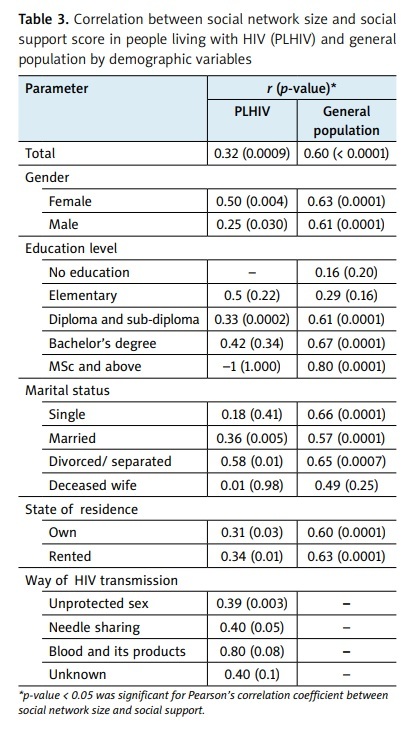
The mean ± SD of social network size in PLHIV (119.98 ± 100.0) was significantly smaller than that of healthy people (161.6 ± 120.3) (p < 0.05). The mean ± SD score of social support in PLHIV (27.7 ± 14.7) was significantly lower than that of healthy people (63.3 ± 33.3) (p < 0.05). In both groups, there was a significant direct correlation between social network size and social support (p < 0.05).
Conclusions:
The social network size and social support are smaller in PLHIV compared with healthy population. Stigma and discrimination related to HIV seem to be the main causes of these results. Programs aiming to reduce stigma and discrimination toward HIV in Iran are suggested.
Social support is an important aspect of life of people living with human immunodeficiency virus (PLHIV), affecting their physical and mental health. Humans receive the most social support from their social networks, characterized as interpersonal social ties. This study aimed to compare social support and social network (its size) among PLHIV and healthy people in Isfahan.
Material and methods:
A case-control study was conducted among 100 PLHIV recruited conveniently and matched with 200 healthy people by random sampling in Isfahan in 2022. Norbeck social support questionnaire and indirect social network size estimation questionnaire were employed. Linear regression in Stata software was used, and significance level of 5% was considered.
Results:
The mean ± SD of social network size in PLHIV (119.98 ± 100.0) was significantly smaller than that of healthy people (161.6 ± 120.3) (p < 0.05). The mean ± SD score of social support in PLHIV (27.7 ± 14.7) was significantly lower than that of healthy people (63.3 ± 33.3) (p < 0.05). In both groups, there was a significant direct correlation between social network size and social support (p < 0.05).
Conclusions:
The social network size and social support are smaller in PLHIV compared with healthy population. Stigma and discrimination related to HIV seem to be the main causes of these results. Programs aiming to reduce stigma and discrimination toward HIV in Iran are suggested.
REFERENCES (30)
1.
Zhao M, Liu B, Zheng T, Xu J, Hao Y, Wang J, et al. Factors associated with hostility among people living with HIV/AIDS in Northeast China: a cross-sectional study. BMC Public Health 2019; 19: 1189. DOI: 10.1186/s12889-019-7526-2.
3.
Aldila D, Aprilliani RR, Malik M. Understanding HIV spread with vertical transmission through mathematical model. In: AIP Conference Proceedings, AIP Publishing LLC; 2018.
4.
AliAkbar H. Modelling of HIV/AIDS in Iran up to 2014. J AIDS HIV Res 2011; 3: 231-239.
5.
de Souza Caliari J, Teles SA, Reis RK, Gir E. Factors related to the perceived stigmatization of people living with HIV. Rev Esc Enferm USP 2017; 51: e03248. DOI: 10.1590/S1980-220X2016046703248.
6.
Forouzan AS, Shushtari ZJ, Sajjadi H, Salimi Y, Dejman M. Social support network among people living with HIV/AIDS in Iran. AIDS Res Treat 2013; 2013: 715381. DOI: 10.1155/2013/715381.
7.
Berg RC, Page S, Øgård-Repål A. The effectiveness of peer-support for people living with HIV: a systematic review and meta-analysis. PloS One 2021; 16: e0252623. DOI: 10.1371/journal.pone.0252623.
8.
Taylor SE. Social support: a review. In: The Oxford Handbook of Health Psychology. Friedman HS (ed.). Oxford: Oxford University Press; 2011, p. 189-214.
9.
Kocalevent RD, Berg L, Beutel ME, Hinz A, Zenger M, Härter M, et al. Social support in the general population: standardization of the Oslo social support scale (OSSS-3). BMC Psychol 2018; 6: 31. DOI: 10.1186/s40359-018-0249-9.
10.
Qi M, Zhou SJ, Guo ZC, Zhang LG, Min HJ, Li XM, et al. The effect of social support on mental health in Chinese adolescents during the outbreak of COVID-19. J Adolesc Health 2020; 67: 514-518.
11.
Ghani NA, Chik WMJW, Abdullah B, Ghazalli FSM. Social support for the HIV/AIDS community: a case study of Komuniti Cakna Terengganu (KCT), Malaysia. Mediterr J Soc Sci 2015; 6: 232. DOI: 10.5901/mjss.2015.v6n1s1p232.
12.
Harandi TF, Taghinasab MM, Nayeri TD. The correlation of social support with mental health: a meta-analysis. Electron Phys 2017; 9: 5212-5222.
13.
Soulsby LK, Bennett KM. Marriage and psychological wellbeing: the role of social support. Psychology 2015; 6: 1349-1359.
14.
Weldesenbet AB, Kebede SA, Tusa BS. The effect of poor social support on depression among HIV/AIDS patients in Ethiopia: a systematic review and meta-analysis. Depress Res Treat 2020; 2020: 6633686. DOI: https://doi.org/10.1155/2020/6....
15.
Zhang T, Cao W, Lv J, Wang N, Reilly KH, Zhu Q, et al. Size, composition, and strength of ties of personal social support networks among adult people living with HIV/AIDS in Henan and Beijing, China. AIDS Behav 2012; 16: 911-919.
16.
Subramanian A, Mohan A, Nandi PK, Rajeshwari K. Perceived social support, depression and their impact on quality of life of people living with HIV in India. AIDS Care 2021; 33: 1329-1334.
17.
Basha EA, Derseh BT, Wubetu AD, Engidaw NA, Gizachew KD. Factors affecting social support status of people living with HIV/AIDS at selected hospitals of North Shewa Zone, Amhara Region, Ethiopia. J Trop Med 2021: 2021: 6695298. DOI: 10.1155/2021/6695298.
18.
Faridvand F, Mirghafourvand M, Malakouti J, Mohammad-Alizadeh S. Relationship between social support and breastfeeding self-efficacy among women in Tabriz, Iran. Br J Midwifery 2017; 25: 103-109.
19.
Sacamano PL. The association of social network factors with healthcare use and outcomes among persons who inject drugs in Baltimore, Maryland. Baltimore; 2018. Available at: http://jhir.library.jhu.edu/ha....
20.
Kroenke CH, Kwan ML, Neugut AI, Ergas IJ, Wright JD, Caan BJ, et al. Social networks, social support mechanisms, and quality of life after breast cancer diagnosis. Breast Cancer Res Treat 2013; 139: 515-527.
21.
Litwin H, Landau R. Social network type and social support among the old-old. J Aging Stud 2000; 14: 213-228.
22.
Hosseini SH, Bahraminejad Z. The role of social support networks in public health and health service utilization among the elderly. J Res Health 2014; 4: 955-961.
23.
Young LE, Tang JL, Schneider JA. Demographic and HIV status diversities as mechanisms of social integration and segregation among Black sexual and gender minorities enrolled in a community-based social network intervention. Soc Networks 2023; 73: 51-61.
24.
Norbeck J. Scoring instructions for the Norbeck social support questionnaire (NSSQ). San Francisco, California, USA: University of California; 1995.
25.
Rastegari A, Haji-Maghsoudi S, Haghdoost A, Shatti M, Tarjoman T, Baneshi MR. The estimation of active social network size of the Iranian population. Glob J Health Sci 2013; 5: 217-227.
26.
Norbeck JS. The Norbeck Social Support Questionnaire. Birth Defects Orig Artic Ser 1984; 20: 45-57.
27.
Zamanian M, Zolala F, Haghdoost A, Baneshi MR. Effect of estimation method, definition of ratio, and the plausible range in estimating social network size. Soc Netw Anal Min 2018; 8. DOI: 10.1007/s13278-018-0513-2.
28.
McLaughlin D, Vagenas D, Pachana NA, Begum N, Dobson A. Gender differences in social network size and satisfaction in adults in their 70s. J Health Psychol 2010; 15: 671-679.
29.
Emlet CA. An examination of the social networks and social isolation in older and younger adults living with HIV/AIDS. Health Soc Work 2006; 31: 299-308.
30.
Kamenov K, Cabello M, Caballero FF, Cieza A, Sabariego C, Raggi A, et al. Factors related to social support in neurological and mental disorders. PloS One 2016; 11: e0149356. DOI: https://doi.org/10.1371/journa....
Share
RELATED ARTICLE
| eISSN: | 1732-2707 |
| ISSN: | 1730-1270 |

We process personal data collected when visiting the website. The function of obtaining information about users and their behavior is carried out by voluntarily entered information in forms and saving cookies in end devices. Data, including cookies, are used to provide services, improve the user experience and to analyze the traffic in accordance with the Privacy policy. Data are also collected and processed by Google Analytics tool (more).
You can change cookies settings in your browser. Restricted use of cookies in the browser configuration may affect some functionalities of the website.
You can change cookies settings in your browser. Restricted use of cookies in the browser configuration may affect some functionalities of the website.